Navigating the Delicate Landscape of Death with Ease, Real-life Stories, and a Deeper Understanding of Life's Final Chapter"Ships don't sink because of the water around them; they sink because of the water that gets in them. Don't let what's happening around you get inside you and weigh you down."
"Ships don't sink because of the water around them; they sink because of the water that gets in them. Don't let what's happening around you get inside you and weigh you down."
My Beloved Ajji: A Varkari's Journey Home 🌼
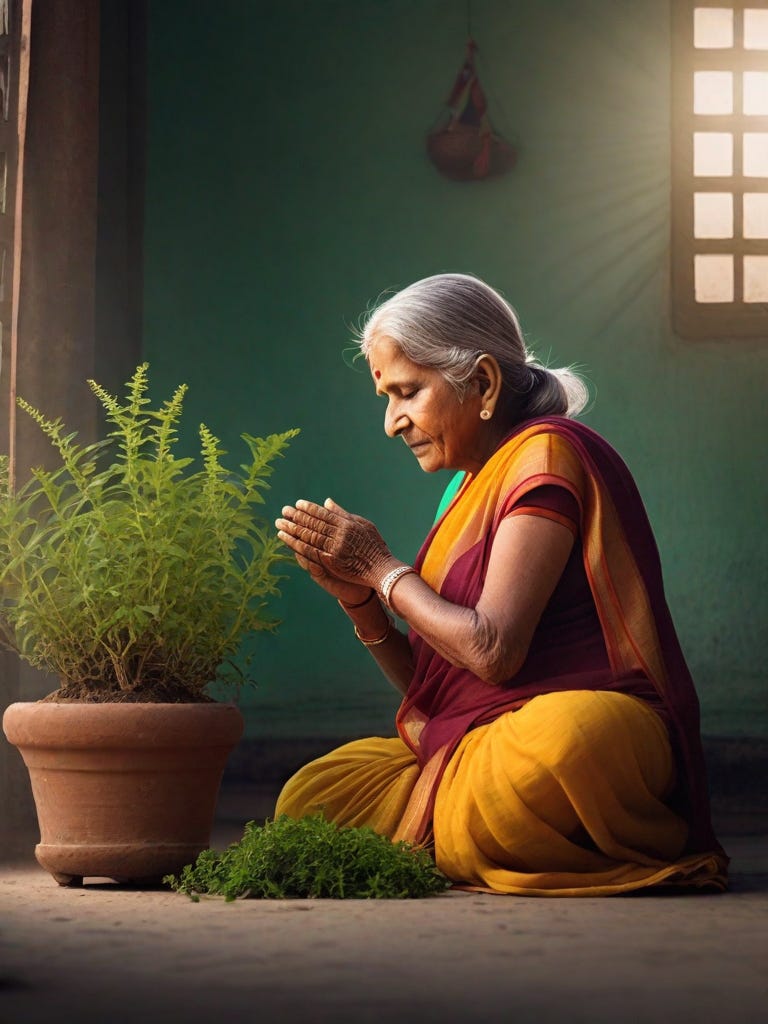
My Great Grand Ma (My Ajji) and her final days,
My dear readers I have been fortunate enough to be the great-grandson of a Varkari, Varkari is a sect in Maharashtra India whose primary deity is Shri Hari Vitthal the real-life manifestation of Shri Krishna. During my Ajji's lifetime, my understanding of Vitthal and the Varkari tradition was a blank canvas. However, observing her daily rituals, behaviors, and eventual passing gradually unfolded the essence of this spiritual journey. Before delving into the intricacies of Ajji's influence on me, let me first articulate my initial perception of Vitthal — an impression that initially labeled him as a 'deity for the less privileged.; In those days, the sight of people donning white attire and embarking on journeys spanning thousands of kilometers for the wari pilgrimage to Pandharpur, the abode of my beloved Vitthal, seemed perplexing. This perplexity was rooted in my own naivety, as I then possessed no knowledge of the Vaishnava sect. However, as time unfolded, my understanding evolved, and what was once a puzzling spectacle became a narrative steeped in the profound concepts and ideologies of the Varkari tradition. The Varkari sect, regarded as a path of devotion (bhakti marg), serves as a conduit toward liberation. Its teachings espouse that the true divinity lies within the atman (Soul), asserting that authentic happiness emanates from within. This philosophy underscores the notion that if materialistic pursuits could provide genuine happiness, humanity would have achieved it by now. Returning to my Ajji, she was a truly unique individual in my life. In my childhood, she would humbly touch my feet, seeking blessings, and affectionately address me as 'Baal Gopal,' the child form of Shri Krishna. This reversal of roles was surprising, as conventionally, I, being a child, should have been the one touching the feet of my great-grandmother. Yet, Ajji, not only elder in age but also spiritually advanced, defied these norms. Her daily regimen comprised awakening at Brahma Muhurat, cleansing herself, and settling into meditation. She would chant the secret mantra bestowed upon her by her guru during initiation, a practice she had embraced decades before our paths converged in this lifetime. I remember her as an incredibly resilient woman who, to support her two daughters, engaged in the trade of selling spices. She faced her fair share of hardships, details of which, at this moment, would not be fair to delve into, throughout the time I spent with her, despite enduring numerous hardships, I never witnessed her express anger or sadness. Also, I never saw her in a state of excessive happiness. Instead, she embodied an emotional equilibrium reminiscent of a sage who had weathered years of austerity. I was a young child when she departed from her physical form, attaining moksha. I vividly recall the serene peace that enveloped her, and I witnessed her soul gracefully departing through her mouth—an exit believed to be the most harmonious in leaving the physical realm. I prefer not to delve into the details of how, in certain instances, life may exit through alternative openings during a natural death. As I pen down these words, tears of joy well up in my eyes. The events play vividly before me, and I hold dear every moment spent with this divine soul. Living under the guidance of a Varkari has been a cherished blessing.
The poignant lesson drawn from this life-altering experience is that a life navigated with resilience surpasses the challenges of a tumultuous death. It urges us to live a life meticulously crafted to ensure a seamless transition—free from the entanglements of religious and ideological conflicts. It calls us to detach from the comforts of the physical vessel, our body, metaphorically echoing the sentiment: let the boat be in the water and not there water in the boat.


Embracing Mortality: Alexander the Great's Final Request 👑
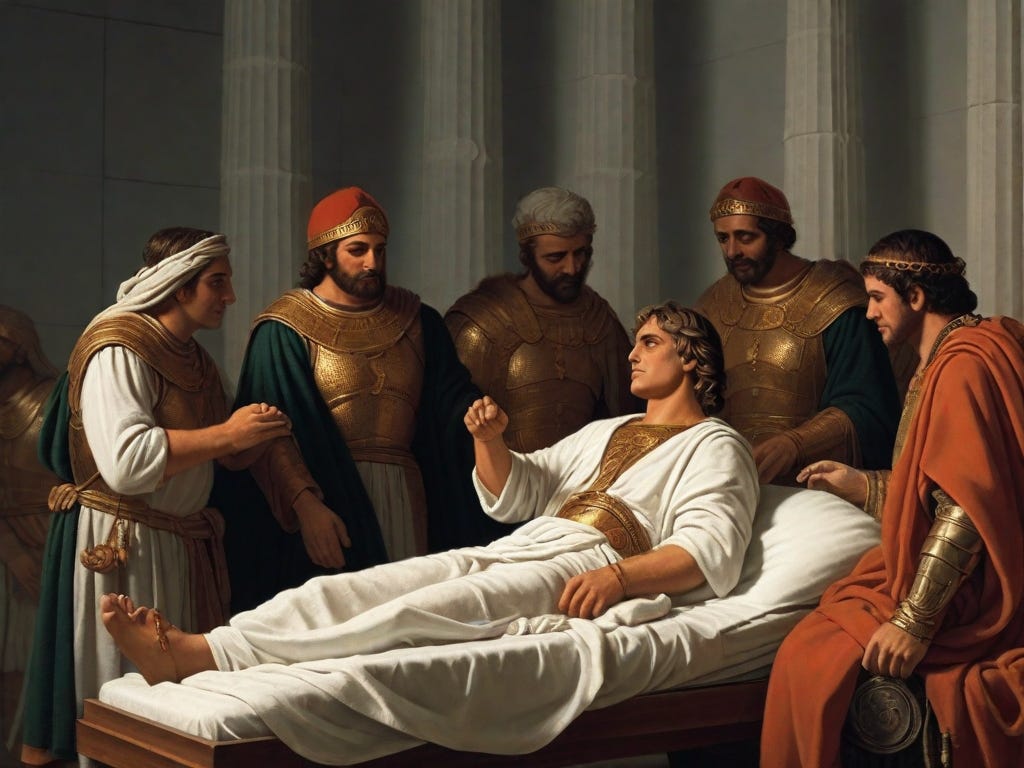
Once, in the vast kingdom ruled by Alexander the Great, the revered conqueror fell grievously ill. As news of his ailment spread like wildfire, anxiety gripped the hearts of his subjects and commanders alike.
Fearing the worst, Alexander summoned the most skilled physicians from across his empire. These learned healers, well-versed in the arts of medicine and healing, gathered at the bedside of the great leader. Despite their collective efforts, Alexander's condition only worsened.
One day, as the sun dipped below the horizon, casting long shadows in the royal chamber, Alexander, weakened but with an unwavering gaze, addressed the assembled doctors.
"Physicians," he began, "I have led armies to victories across lands, but today I face a battle within myself that even the mightiest army cannot conquer. My time in this world is nearing its end." 🌅
Hearing these words, the physicians were overcome with sorrow, for they knew the limits of their healing arts in the face of mortality.
But Alexander, in a surprising display of acceptance, continued, "I have fought battles, conquered nations, and amassed wealth beyond measure. Now, as I approach the threshold of the unknown, I ask you to accept my fate with open hands." 🌍
Perplexed, the doctors exchanged glances. Alexander, sensing their confusion, explained, "Do not mourn for me, for the journey that awaits is one every mortal must undertake. Instead, accept my body with open hands, and let it return to the earth from which it came." 🌱
In the twilight of his life, Alexander the Great, in a moment of reflection and wisdom, purportedly summoned his generals to articulate three profound wishes. Firstly, he requested that the best doctors bear the weight of his coffin, symbolizing the futility of earthly prowess in the face of mortality. Secondly, he wished for his accumulated wealth to be scattered along the funeral procession, emphasizing the transient nature of material riches.
However, the most poignant of his wishes was the third: that his hands be left free, hanging outside the coffin for all to witness. This act, according to the legend, carried a deeper message—a culmination of a lifetime's understanding. Alexander sought to share an enlightenment with his subjects, urging them not to tread the path of world conquest, but rather to conquer the inner realms of fear and uncertainty. 🌟
In this final gesture, Alexander implored his people to embrace a life of contentment and well-being, transcending the relentless pursuit of external conquests. His ultimate wish was for his legacy to be a beacon, guiding his subjects towards a path of conquering their own fears and finding fulfillmentin a happy, healthy existence. 🌈
CONCLUSION 🖋️
नैनं छिन्दन्ति शस्त्राणि नैनं दहति पावकः । न चैनं क्लेदयन्त्यापो न शोषयति मारुतः ।।
No weapon can cut the soul into pieces, nor can it be burned by fire, nor moistened by water, nor withered by the wind. { GEETA 2.23 }
In reflecting upon revered figures like Nikola Tesla, Jesus, Guru Teg Bahadur, Socrates, and Gautama Buddha, it becomes apparent that their physical deaths were marked by challenges. Yet, the reason we hold them in high esteem transcends these earthly struggles. Their profound understanding of the eternal nature of the soul encourages us to contemplate life beyond the physical realm.
In a world where the pursuit of truth and happiness is paramount, their examples emphasize the importance of meditation and living authentically. Through introspection and embracing a genuine and joyful existence, we can strive to connect with the eternal essence within ourselves. Thus, their enduring legacies inspire us not just to admire, but to actively pursue a true and fulfilling life. 🌟🧘♂️
Closing Note:
As we conclude this newsletter, I send warm wishes for a Shubh Diwali to all my cherished readers. 🪔 May the radiant insights shared here add a spark to your celebrations. If you found this letter enlightening, please show your support by liking, sharing, and subscribing. 🌟 And, as Diwali is a time of inner light, consider embracing the transformative power of meditation. It's not just a practice; it's a journey within. 🧘♂️ Wishing you moments of peace, joy, and mindful reflection. Until our paths cross again, stay enlightened and connected! 🙏
Yours, Vishal Rajput ❤️