Agama's Message: Your Gateway to Holistic Living, Meditation, Productivity, Astrology and an Alpha Mindset. Explore the wisdom and practices that empower your journey to a balanced, purpose-driven life.
Search This Blog
🌟The Holy Trinity
The Brahma - The Vishnu - The Mahesh
Dear Amazing Reader,
🌟 Today was meant to be a newsletter about the 4 Yugas and the Brahma-Vishnu-Mahesh Trinity. However, as I began penning down the intricate details, I felt it would be unjust to cram these profound concepts into a short newsletter. 📜
As I delved into explaining the three forms for Vishnu followers and the three forms of Shiva, the realization struck me - this newsletter could turn into an endless cosmic exploration! 🚀
So, here's the plan: I've decided to turn this into a captivating series. We'll start by unraveling the mysteries of Brahma, Vishnu, and Shiva, and then gracefully transition into the enchanting saga of the 4 Yugas. 🔄 I hope this series does justice to the profound message I aim to convey.
A massive shoutout to all of you wonderful subscribers! 🙏 Your regular visits to Agama's Message and the overflowing love you shower on this humble attempt to unwrap the profound philosophy of the Vedas are nothing short of heartwarming. You, yes you, are the real stars of this cosmic show! 🌌
So, grab your cosmic popcorn, let's delve into the secrets of the Yugas and dance with the cosmic trinity! 🕺💫
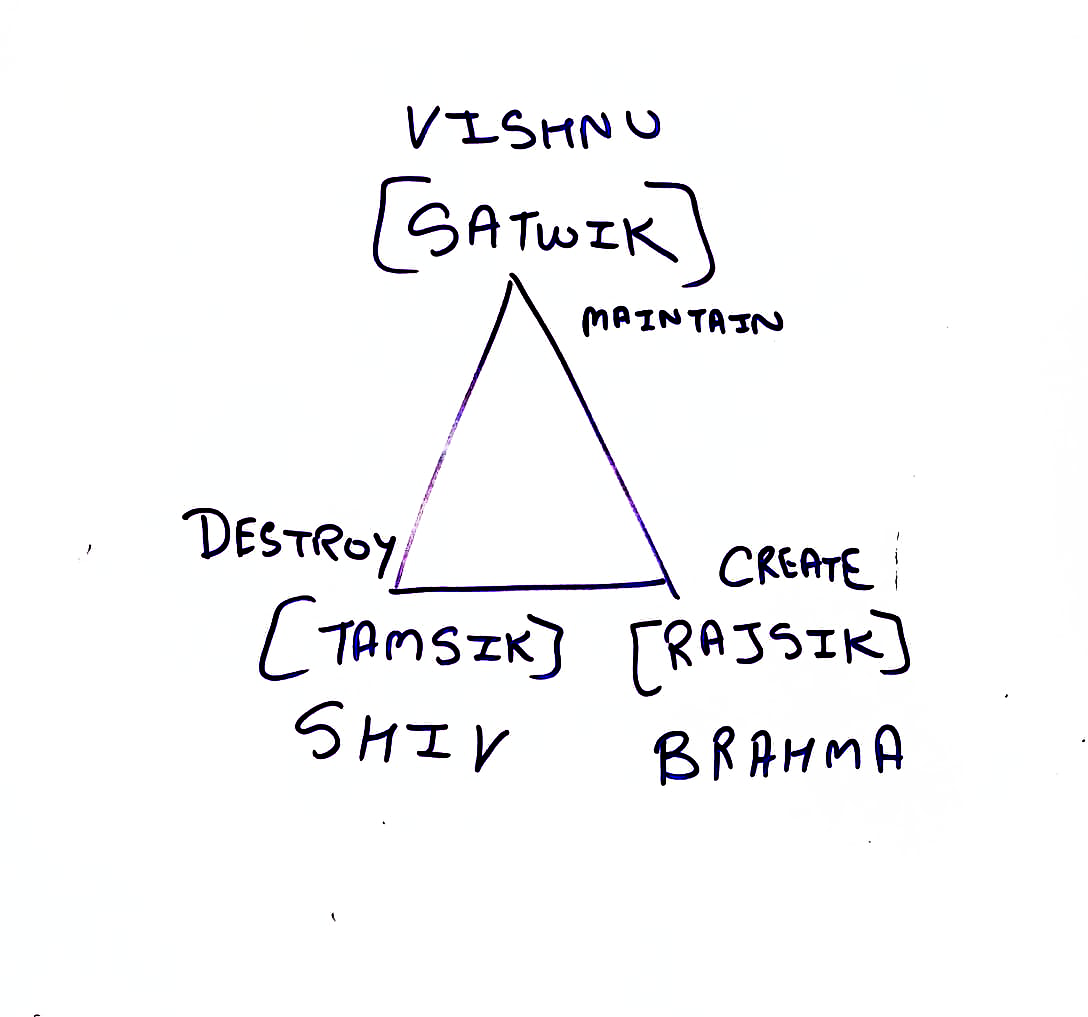
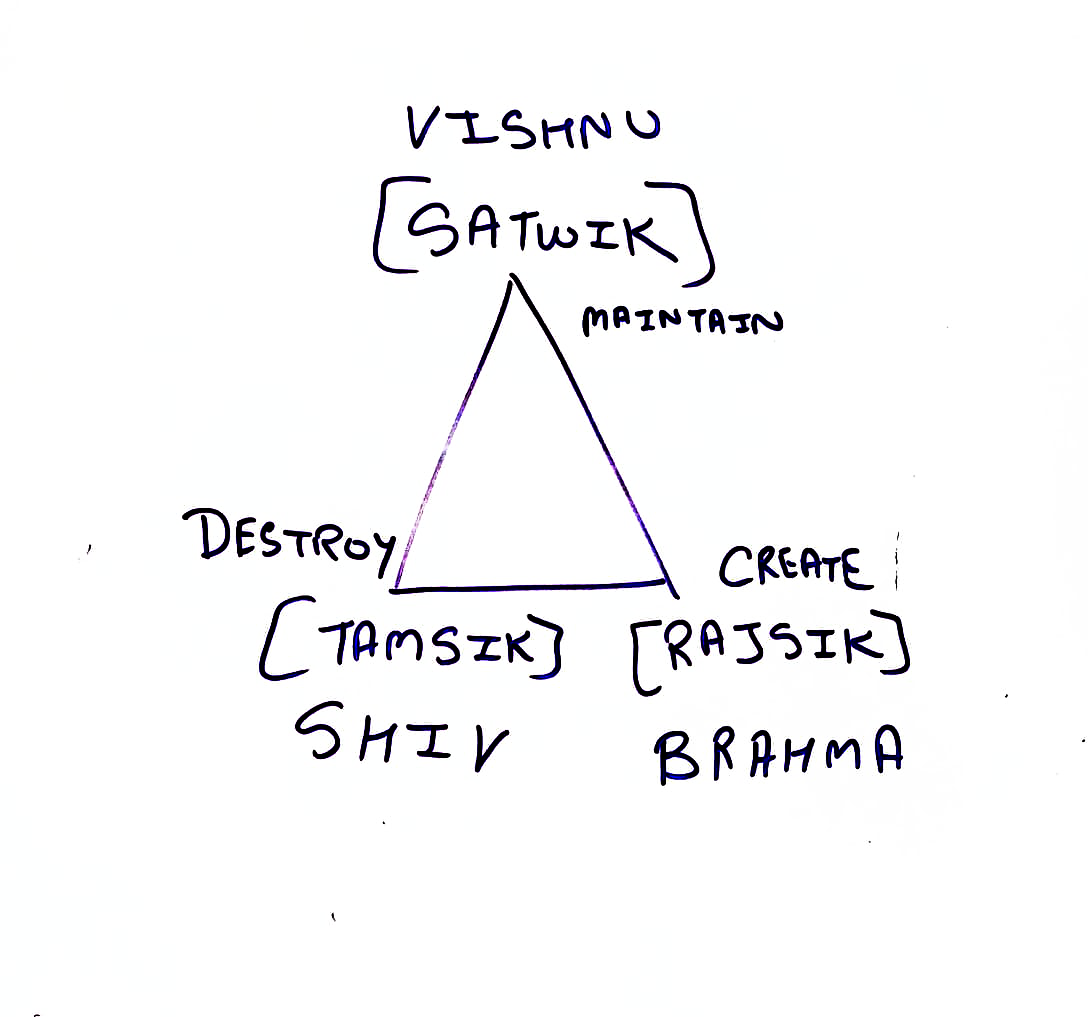
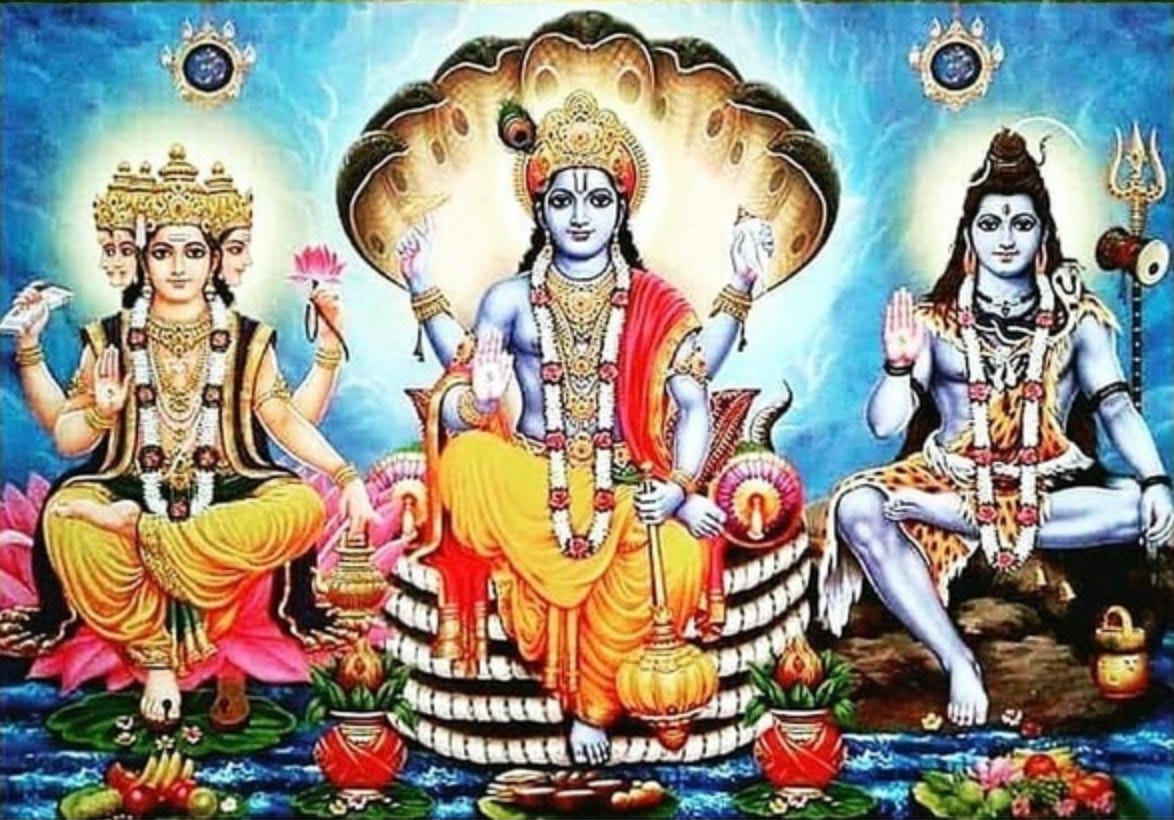
Holy Trinity: The Brahma, The Vishnu, The Shiv
All 3 are Satvik in nature but their individual roles require specific guna which is described in the diagram. Shiv and Vishnu are supreme and have equal importance and it depends on individual kundali / horoscope as to which path one should follow, Shaivism or Vaishnavism. (All paths lead to the same destination)
3 Forms of Shri Vishnu
1. Mahavishnu - The Origin of Creation:
Mahavishnu, the cosmic creator, initiates the dance of creation by forming the total material energy, known as the mahat-tattva.
This form serves as the source of all material existence, setting the stage for the grand cosmic spectacle. 🌌
2. Garbhodakashayi Vishnu - The Architect of Universes:
An expansion or overflow of Mahavishnu, Garbhodakashayi Vishnu, enters into each universe to create diversities and sustains the cosmic order.
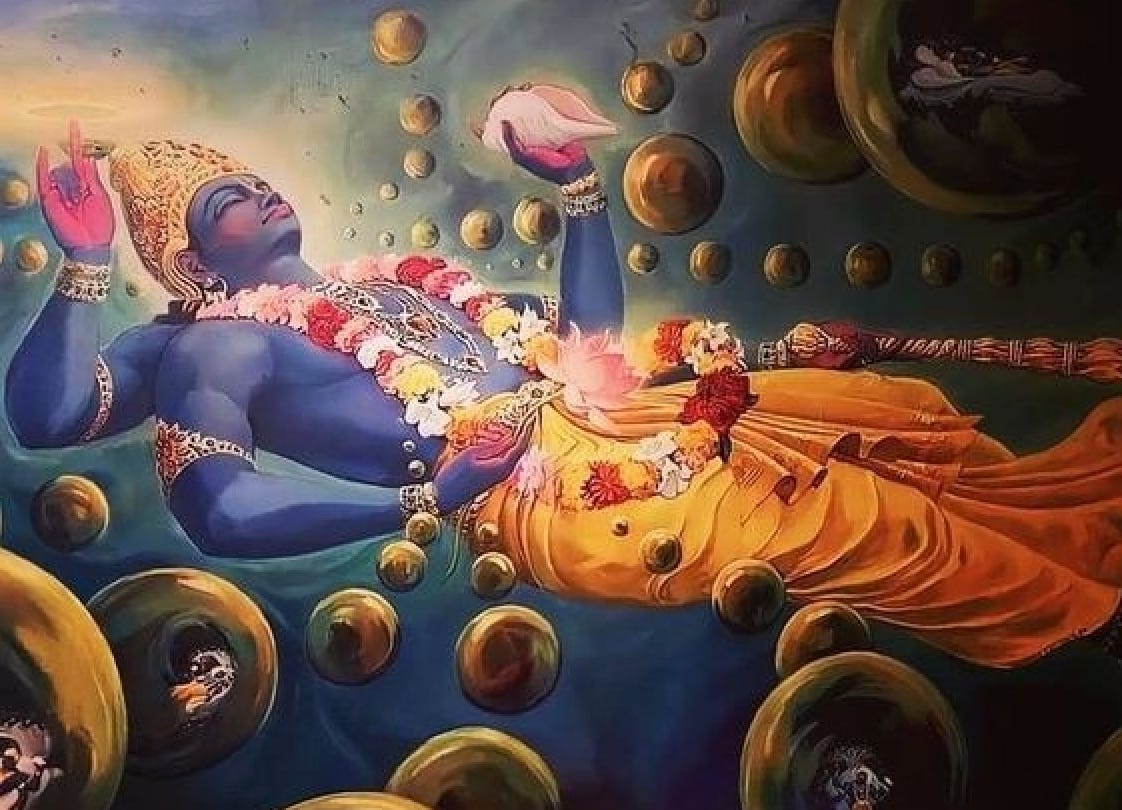
Realized as the form of Pradyumna within the material universe, he is the father of Brahma, the creator, emerging from His navel. 🌍
3. Ksirodakashayi Vishnu - The Immanent Super Soul:
Ksirodakashayi Vishnu, the all-pervading super soul, diffuses within all universes and resides in the heart of every living being as Paramatma.
As the four-handed Vishnu, the goal of life is to know Krsna, the Supreme Being situated within the heart of every living being. ❤️
शान्ताकारं भुजगशयनं पद्मनाभं सुरेशं
विश्वाधारं गगनसदृशं मेघवर्णं शुभाङ्गम् ।
लक्ष्मीकान्तं कमलनयनं योगिभिर्ध्यानगम्यं
वन्दे विष्णुं भवभयहरं सर्वलोकैकनाथम् ॥
Meaning:
1: (I Meditate on Lord Vishnu) Who has a Serene Appearance (which fills our inner being with Peace); Who is Lying on (the Bed of) Serpent (Ananta or Adisesha, representing the eternal Primal Energy or Mula Prakriti); From Whose Navel is springing up a Lotus (which is the source of all Creations through Brahmadeva); and Who is (presiding over the various elements of those Creations as) the Lord of the Devas,
2: Who is the Substratum of the whole Universe (as Consciousness); and (Boundless and Infinite) like the Sky (Chidakasha); with a Form Bluish in Colour like the Cloud, (The Form) which is radiating Auspiciousness (which fills our inner being with Bliss);
3: Who is the Beloved of Devi Lakshmi with Eyes Beautiful like Lotus petals; Who is Attainable by the Yogis only through (Devotional) Meditation,
4: I Worship that All-Pervading Vishnu Who Removes the Fear of Worldly Existence (by making us realize that we are not isolated beings internally but are eternally connected to Him); I Worship that Vishnu Who is the One Lord of All the Lokas (Worlds).
3 Forms of Shiva: Shiv, Rudra, Sadashiv
1. Shiv:
Essence and Consciousness:
Nada and Bindu: Shiv represents pure consciousness, often associated with Nada (vibration) and Bindu (Shakti tattva) in the observable universe.
Mantra-Maya Sharira: Shiv's body is described as a mantra-maya sharira, a manifestation resonating with the entire cosmos.
Cosmic Play and Universe Adornment:
Bindu's Play: Bindu, symbolizing Shakti, propels the cosmic play, manifesting as planets, beings, and galaxies.
Universal Skeleton: Shiv is the underlying universal skeleton, adorning different forms of the universe.
2. Rudra:
Ancient Vedic Deity:
Fierce Storm Deity: Rudra was worshipped as a fierce celestial deity of storms in ancient Vedic traditions.
Red or Fierce: Both Rudra and Shiva are described as red or fierce in their appearances.
Duality of Destruction and Protection:
Fear and Awe: Feared for their potential to cause destruction, death, and disease, but also revered for their protective aspects.
Ancient Healers: Rudra and Shiva were considered ancient healers and Gods associated with roaring storms.
Archetypal Attributes:
Shared Attributes: Rudra and Shiva share attributes like the Tandava dance, ash-clad appearance, three eyes, damaru, pot of fire, and ascetic life.
Archery Connection: Rudra's description as an archer in the Rigveda aligns with Shiva's attribute as an archer in the Mahabharata.
3. Sadashiva:
Philosophical Essence:
Equilibrium: Sadashiva represents the philosophical aspect of Shiva, embodying the equilibrium between knowledge energy (jana shakti) and action energy (kriyā shakti).
Penultimate Materialization: Mahesha is considered the penultimate materialization of the transcendent god.
Manifestations and Lingam Form:
Chola Era Worship: Worship of Shiva as Sadashiva was prevalent during the rule of the Chola kings in South India.
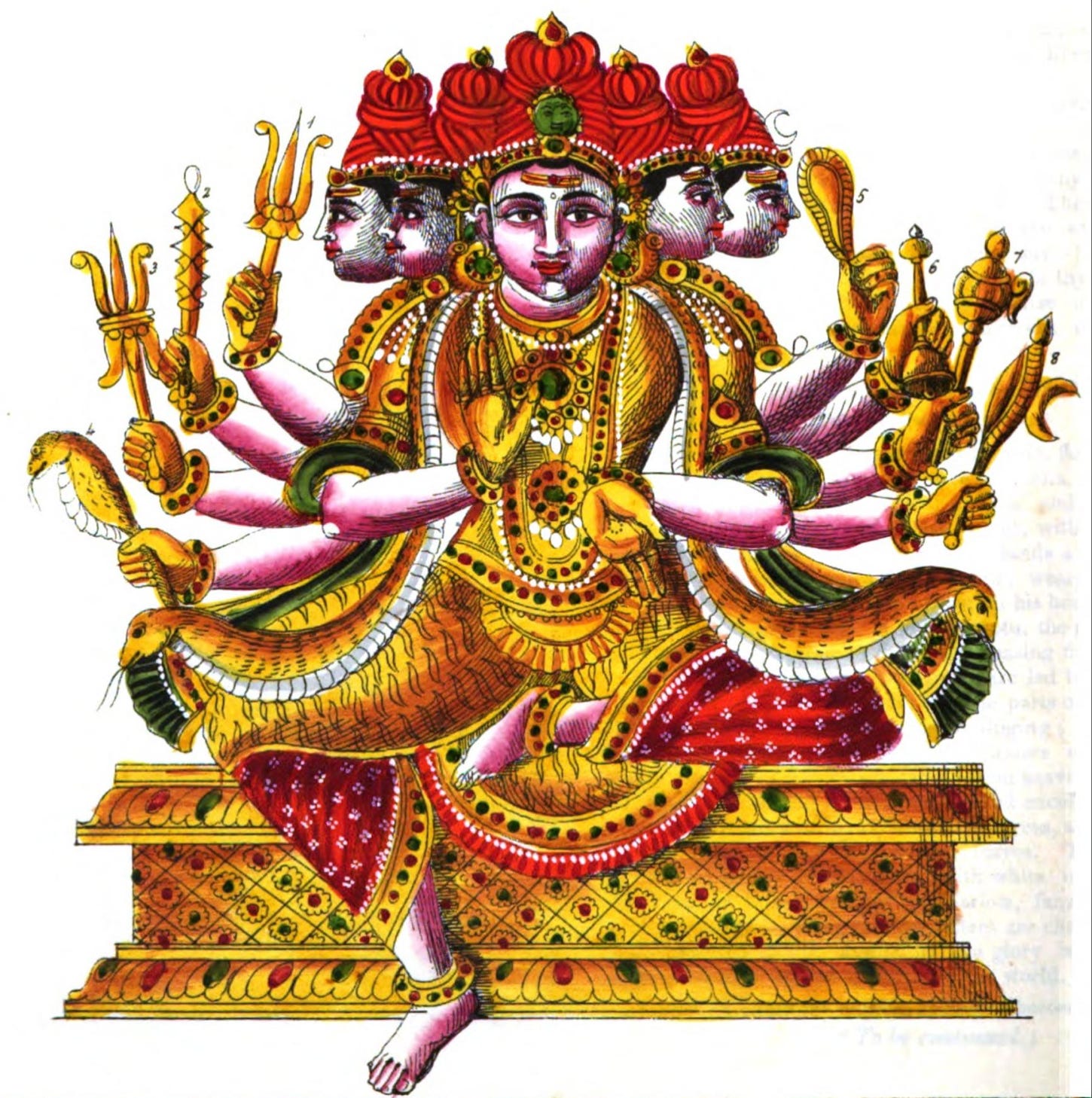
Lingam Representation: In the Lingam form, Sadashiva has five faces representing cosmic elements and functions.
Panchamukha Shiva:
Representation: An image or idol with five faces, symbolizing the sacred number for Lord Shiva.
Significance: Each face represents specific aspects related to elements, senses, organs of perception, and organs of action.
Anahata Chakra and Sadasiva Tattva:
Eternal Benefactor: Sadashiva in Anahata Chakra is the eternal benefactor, representing a state of equilibrium.
Sadasiva Tattva: Equilibrium between Shiva's knowledge energy and action energy, represented with five heads in Saiva rituals.
Brahma is a key deity in Hinduism, specifically known as the God of creation.
Visualized with four faces, representing his role in creating living beings.
Role and Attributes:
Brahma is credited with the creation of the four Vedas, essential scriptures in Hinduism.
Believed to reside in a distinct realm known as Satyaloka.
In Hindu mythology, he is the spouse of Saraswati, and the sage Narada is considered his son.
Representation:
Often depicted seated on a lotus and adorned with a beard.
Interestingly, there are no dedicated temples constructed for the worship of Brahma.
Brahman:
Supreme Entity:
Brahman, as outlined in the Upanishads, is the Supreme Entity in Hindu philosophy.
It is characterized as omnipresent and beyond direct perception with the naked eye.
Experience and Realization:
Unlike Brahma, Brahman is not a deity to be seen but an entity to be experienced and realized.
Sages attain a state of realization after experiencing Brahman, transcending ordinary perception.
Characteristics:
Brahman is described as all-pervasive, existing in every nook and cranny of the universe.
It is considered indestructible, devoid of any specific shape or color.
Advaita Philosophy:
According to the philosophy of Advaita propagated by Sankara, individual souls are fragments of the Supreme Brahman.
The ultimate goal is for individual souls to merge with Brahman upon liberation from the human body.
Control and Manifestation:
Brahman is conceptualized as the supreme controller, orchestrating the manifestation and control of the entire cosmos.
Maya, or illusion, is attributed to Brahman, creating the perception of duality in the world.
Illusion and True Knowledge:
Maya gives rise to the illusory appearance of the universe, akin to perceiving a snake in insufficient light where there is only a rope.
True knowledge dispels the illusion, affirming the saying, "Brahmaiva Satyam Jagan Mithyaa" – 'The Supreme Brahman alone is the truth, the universe is illusory.'
Effects of Realization:
Individuals who attain realization of Brahman see its presence everywhere.
Such realized souls gain mastery over their minds and remain undisturbed by the dualities of life.
Conclusion: 🌌 Unlocking the Mysteries of Brahma, Vishnu, and Mahesh
In this edition of Agama's Message, we embarked on a journey through the cosmic realms, unraveling the profound concepts of Brahma, Vishnu, and Mahesh. I hope these insights have cast a light on the divine trinity, bringing clarity to their roles and the cosmic dance they engage in to maintain equilibrium. 🕉️✨
Exploring the differences and nuances of Brahma as the creator, Vishnu as the preserver, and Mahesh as the destroyer, we've delved into the intricate tapestry of Vedic wisdom. It's a humble attempt to convey these complex concepts with the understanding that variations exist within the vast expanse of Vedic realms. 🎨📜
Your support and love for Agama's Message are truly appreciated. If this edition has sparked your curiosity and you crave more knowledge, consider exploring our other newsletters filled with profound insights. Your engagement, whether through likes, shares, or subscriptions, fuels the continuation of this journey. 🚀📖
I extend a warm invitation to our readers to become guest writers and share your knowledge. The Vedic realms are vast, and diverse perspectives enrich the tapestry of understanding. With humility and acknowledging the limitations of my own knowledge, I present this edition, recognizing the multitude of interpretations that exist. 🤝🌐 CLICK HERE TO KNOW MORE ✒️
Thank you for your unwavering support and the love you've shown. Your continued readership is a testament to the shared exploration of the profound philosophy embedded in the Vedas. Until our next edition, may the cosmic energies guide your path. 🌌🙏
Like, share, and subscribe to stay connected with the ever-unfolding mysteries of Agama's Message! 📚✨🌟
🌟 Journey to Sthitapragya: Your Path to Inner Harmony and Spiritual Freedom 🌟 "Meditation brings wisdom; lack of meditation leaves ignorance. Know well what leads you forward and what holds you back, and choose the path that leads to wisdom." — Buddha Dear Beloved Readers, Today, let's embark on a soul-enriching voyage, diving deeper into the profound essence of "Sthitapragya" – a state of emotional equilibrium that illuminates the way to spiritual liberation. 🧘♂️